The Cost of Not Asking
A business changes hands. The seller's lawyers handle the digital assets correctly. Transition support is offered and vouched for. The buyer declines to engage. Two years later, the cost is measurable, and still compounding.
What was in place
A local service business had traded for 17 years. Over that time, its website and domain had accumulated significant search authority, initially built in a period of low local competition, when simply having a website and being consistent was enough to establish strong visibility.
The digital estate was properly governed. When the business was sold, the incumbent IT provider held the website and domain names as part of a structured transition. The seller's legal team had the digital assets on the checklist. The website and domains were available, correctly documented, and ready to transfer to the new owner.
Transition support was offered by the incumbent, someone who had built the digital infrastructure over the lifetime of the business. The offer was vouched for by the seller directly.
What the buyer decided
The buyer declined the transition support. The incumbent was not engaged. The buyer's own IT provider, brought in to handle the new setup, also declined to engage.
Along the way, a decision was made to build a new website on freshly registered domains. The established domains - available and ready to transfer - were not taken up. The accumulated search history and authority built over 17 years was left behind.
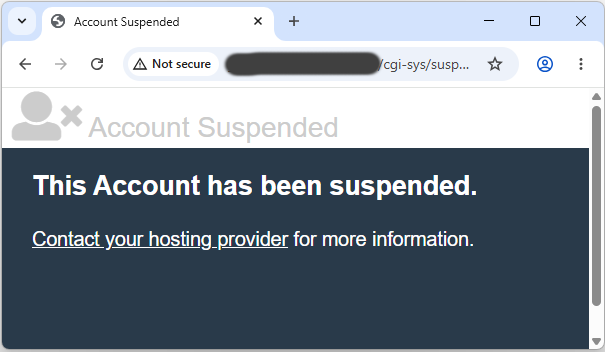
The buyer eventually transferred the established domains to a new registrar, but their DNS was never updated. The domains were renewed annually, but left pointing to the original hosting platform, which resolved to a suspended account page.
What two years looks like
The suspended account page on the original domains received over 700 page requests every week. Not all of that was bot traffic. A proportion would be real local demand, people in the catchment area, looking for this business, arriving at a closed door.
- The established domains renew annually, pointing to a suspended hosting page
- The suspended page received 700+ page requests every week
- The business entity panel had been lost from Google Search
- The business relegated to the page bottom of local search
- The business appeared in the map pack but not in the visible listings
- There are now 20+ competitors ranked higher on the same search results pages
When the business first came online, there were two or three local competitors. The domains accumulated 17 years of authority in a low-competition environment. That authority remained attached to the original domains. It cannot be transferred to the new site by any technical means other than the original domains.
The new domains are now trying to enter a 20+ competitor market with no search history, while the domains that won the previous 17 years of local search sat pointing at a suspended page.
The lesson is not technical
The information was available. The transition support was offered and vouched for by the seller. The digital assets were correctly documented and ready to transfer.
But still the process failed.
If you don't understand what you're being told during a business acquisition, or technical hand-over, ask someone who does - find someone whose job it is to know.
Digital assets are real property with real value. Domain authority, search visibility, and entity recognition are built over years and can be lost in weeks. They belong on every acquisition checklist, and when technical advice is offered by an incumbent who knows the estate, the right response is to have your own people assess it, not to decline it.
A note on evidence
The traffic figures referenced in this case study were drawn from raw server access logs, not analytics, estimates, or third-party tools. The raw log data confirmed consistent inbound traffic to domains that had pointed to a suspended page for two years.
This is what digital governance looks like in practice. Not a projection. Not a forecast. A record of what actually happened, month by month, to an asset that was maybe forgotten, probably misunderstood, though a valuable asset nonetheless; not realised at best, but squandered in truth.
Business type and identifying details have been anonymised.
Buying or selling a business?
ScotDigital can assess the digital estate as part of your due diligence, what the domains hold, where the authority sits, what a transition plan should include, and what questions to ask before contracts exchange.
Get in touch Clarity Review